- The size of a flashlight - depends on the use
- Lumens, luxes and candelas - and how to measure them
- ANSI/NEMA FL1 -standard
- Valostore's VALOLAB - Introduction
- Info about IP-classification
- Info about ATEX
- Lumonite 5 year warranty
- Lumonite at MIL-STD and Toptester -tests
- Purelux PowerBoost™
- Halogen, Xenon or LED auxiliary light?
- Auxiliary light for electric car
- Purelux Panther
- ATV Lighting
- Wood truck lighting
- Led strips in home lighting
- Suitable amount of lights in different rooms
- What kind of auxiliary lights are legal options for German traffic?
Suitable amount of lights in different rooms
Properly designed lighting makes a home cozy, practical and safe. Good lighting does not just mean one bright ceiling light, but also the balance, layering and adaptability of light to different situations. When the amount and quality of light are right, the space works better and feels more pleasant. In this article, we will go through how much light is needed in different rooms of the home and what kind of lighting solutions should be used.
How to calculate the right amount of light for your home
Estimating the amount of light is easier than many people think. When you know the size of the room and the desired number of lumens per square meter, a simple calculation is enough:
- Room area (m²) × lumens/m² = total lumens.
- You can find the recommended room-specific lighting levels on the page below
For example, in a 25 square meter living room, an overall light level of 200 lm/m2 means 25 × 200 = 5000 lumens. If one downlight produces 700 lumens, the appropriate number of lights is about 7-8 (7-8 x 700 lm = 4900 - 5600 lm). This way the lighting is balanced and not too bright or uneven.
The height of the room affects how much light is needed
- In low rooms (less than 2.7 m), the light is distributed more densely, so a lower amount of lumens is enough to achieve the same level of lighting.
- In high rooms (over 2.7 m), it is worth increasing the power or number of lights slightly so that the light reaches the living area properly. For example, in a 3.2 meter high ceiling, it is worth choosing the amount of light at the upper end of the recommended amount in the room.
The light should be distributed evenly, so several smaller lights work better than one bright ceiling light. Downlights or ceiling panels create even general light, and this can be supplemented with indirect light - for example, LED strips at the ceiling edge, behind shelves or behind the TV. Decorative pendant lights and floor lamps bring liveliness to the space and allow for a change of atmosphere for different situations.
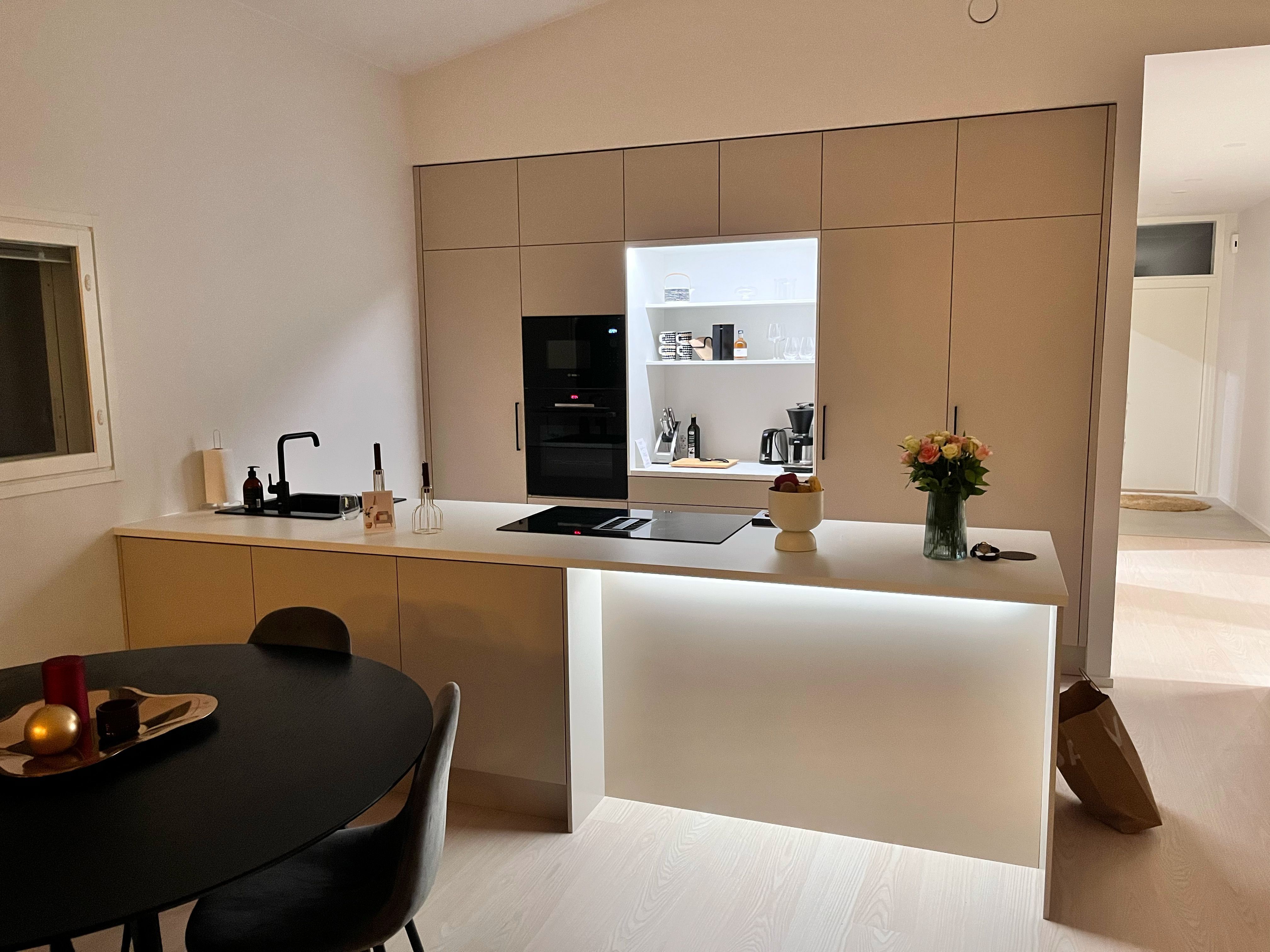
Living room – lighting a multi-purpose space
- Suitable general lighting: 150–250 lm/m²
- 150 lm/m² = calm general light
- 250 lm/m² = bright general light
The living room is the heart of the home, where lighting must be suitable for a variety of situations. It is the space where people spend time with their family, watch TV and relax, but it must also function during cleaning and everyday chores. The appropriate amount of general lighting in a living room is approximately 150–250 lumens per square meter. For example, in a 25 m² living room, this means approximately 3750–6250 lumens of total light output.
Bedroom – calm and variable lighting
- Suitable general lighting: 80-150 lm/m2
- 80 lm/m² = calm general light
- 150 lm/m² = brighter general light
In the bedroom, the most important task of lighting is to create a calm and restful atmosphere, but it must also be bright enough for dressing and cleaning. A good amount of general light in a bedroom is around 80–150 lm/m², so for example a 15 m² room needs 1200–2250 lumens.
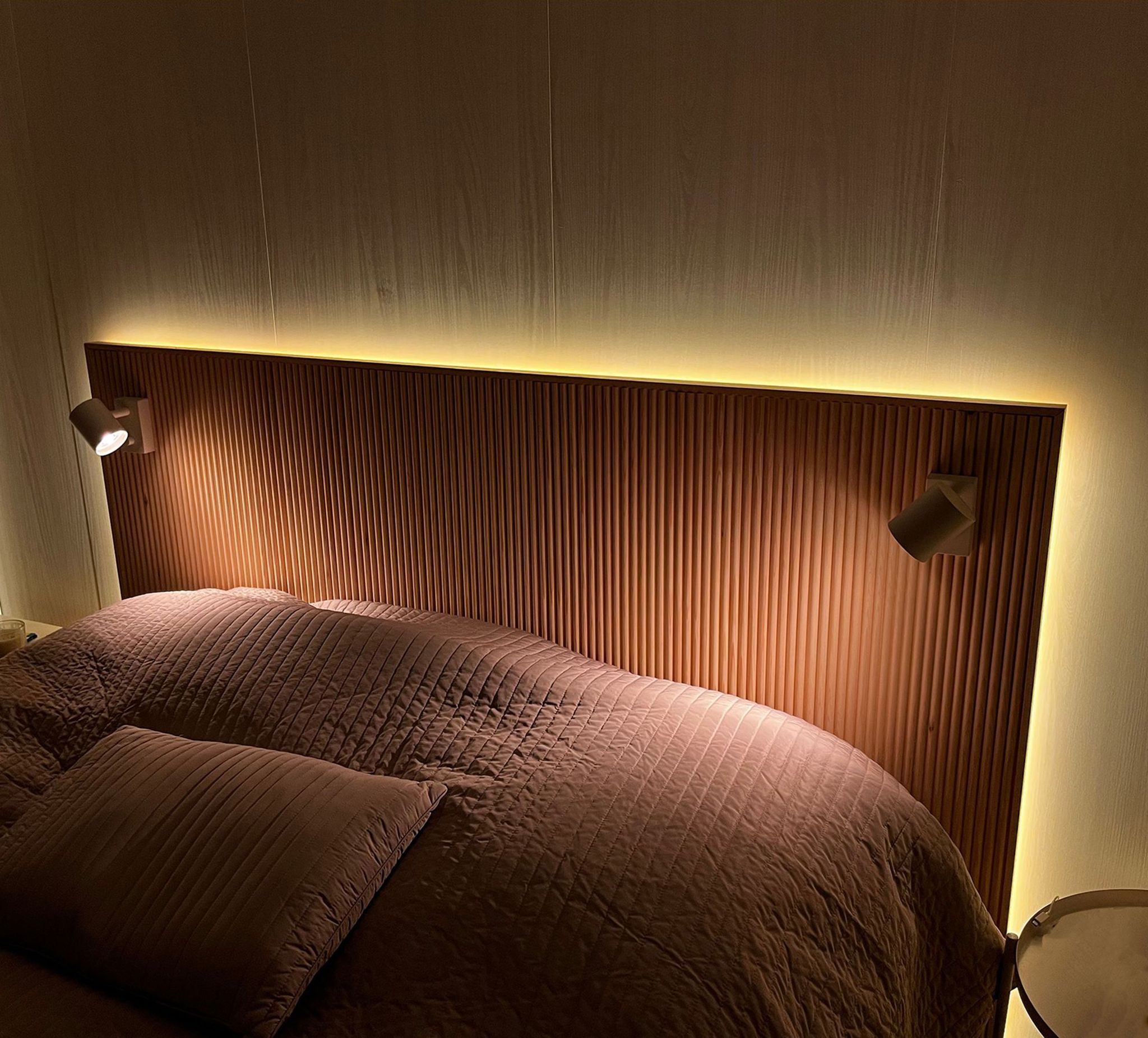
Downlights or a ceiling light create even basic lighting, and can be supplemented with bedside reading lights or a soft LED strip as indirect mood light. Dimmable lighting is particularly important in the bedroom. If the room has a dressing area or a mirror cabinet, brighter spotlights make it easier to choose clothes.
Kitchen – lighting for a functional space
- Suitable general lighting: 150–250 lm/m²
- 150 lm/m² = calm general light
- 250 lm/m² = bright general light
In the kitchen, the importance of lighting is emphasized, as it directly affects the comfort and safety of cooking and cleaning. The amount of general light in the kitchen can be the same as in the living room (150–250 lm/m²), but even more targeted light is needed in work areas.
LED strips or downlights directed above the worktops produce efficient and shadow-free light – the recommended output is approximately 1000 lm/m or 10–15 W/m. It is advisable to direct the worktops so that they do not dazzle, but evenly illuminate the worktops. In addition, indirect lighting above the upper cabinets brings a warm and finished atmosphere to the kitchen.
Office – efficient and concentration-supporting lighting
- Suitable general lighting: 150–250 lm/m²
- 150 lm/m² = calm general light
- 250 lm/m² = bright general light
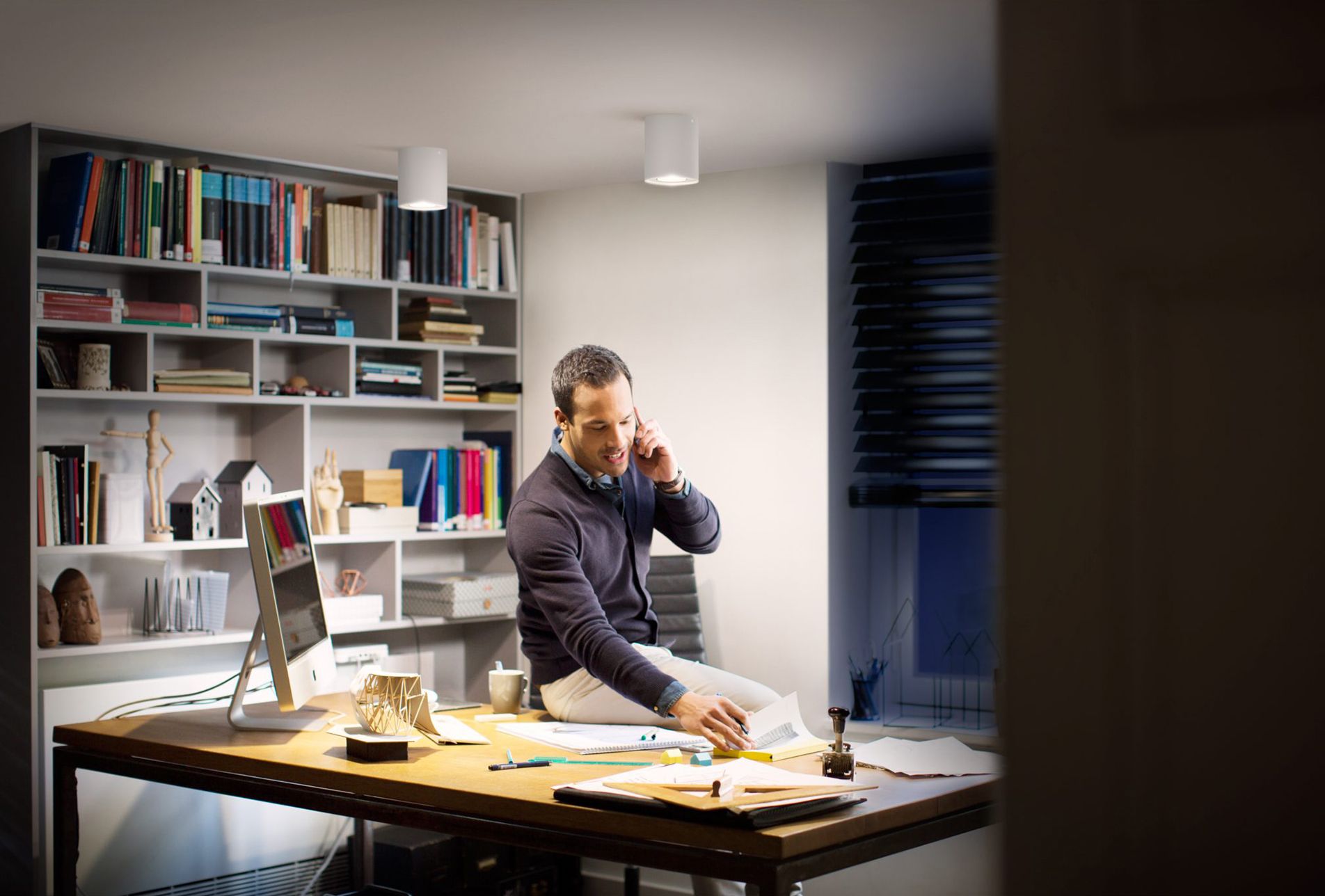
The quality and amount of lighting in the workplace directly affect concentration and stamina. The amount of general light is sufficient (150–250 lm/m²), but it is worth adding bright and directional spotlights to the work area.
A desk lamp with adjustable brightness and color temperature makes working ergonomic and easy on the eyes. The lighting of the work area can also be handled with a spotlight placed on the ceiling above the work area. Cooler light (4000–5000 K) supports alertness during the day, while warmer light (2700–3000 K) calms down in the evening. This way, the lighting adapts to different work rhythms and times of day.
Warehouse – a functional and efficient workspace
- Suitable general lighting: 150–250 lm/m²
- 150 lm/m² = calm general light
- 250 lm/m² = bright general light
In warehouses or hobby rooms, the lighting needs are similar to those in a workroom. 150–250 lm/m² is recommended for general lighting, and more efficient spotlights can be added to shelf areas or above workbenches.
In long and high warehouses, the placement of luminaires is particularly important: the light should be directed downwards and installed as evenly as possible. Luminaires equipped with motion sensors increase energy efficiency and user comfort in small warehouses.
Bathroom – safety and atmosphere
- Suitable general lighting: 80-150 lm/m2
- 80 lm/m² = calm general light
- 150 lm/m² = brighter general light
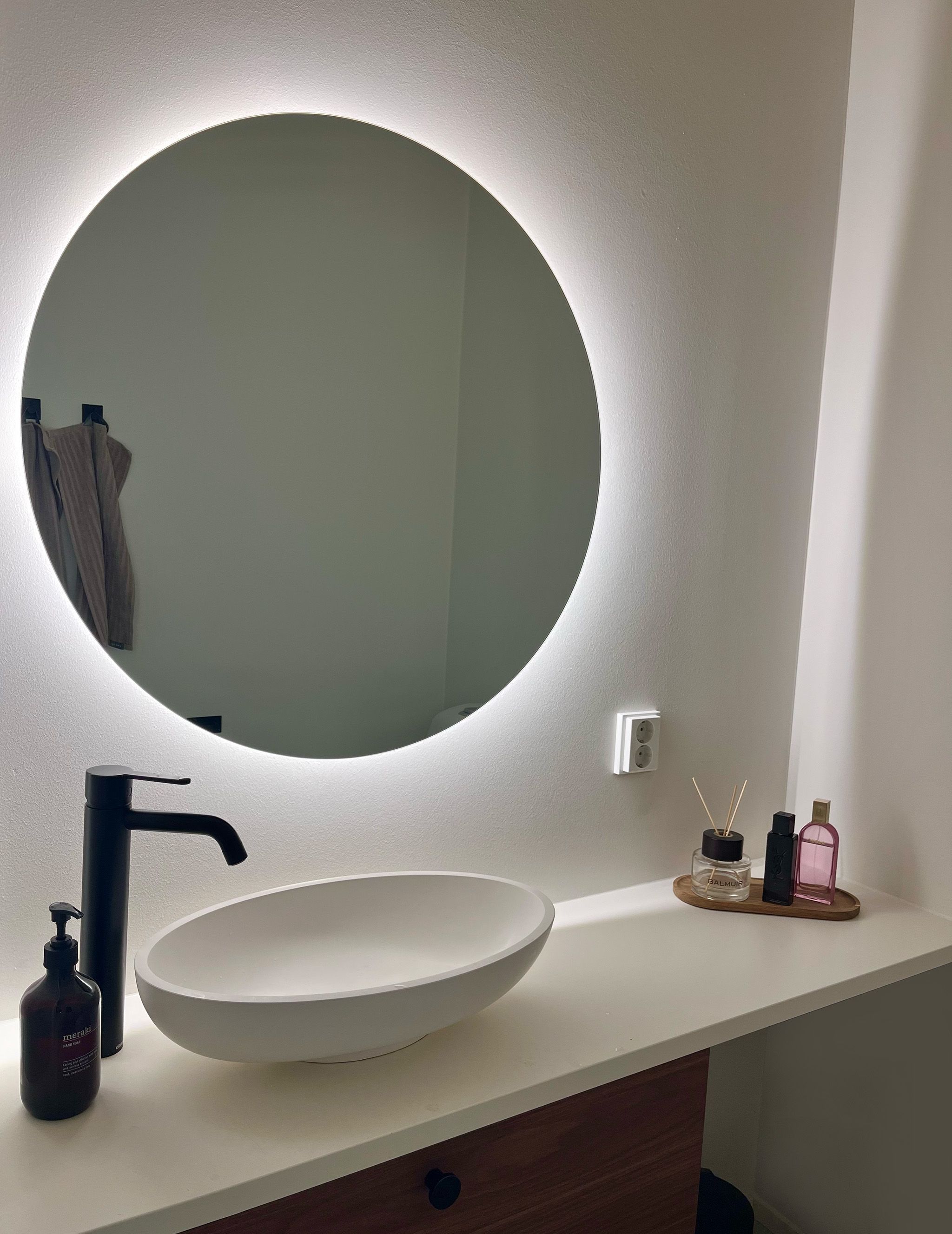
In the bathroom, lighting should be both functional and safe. Luminaires require sufficient moisture protection, at least IP44, preferably IP65 in the shower. The appropriate amount of light for general lighting is 80–150 lm/m², i.e., for example, about 1600–2400 lumens in an 8 m² bathroom.
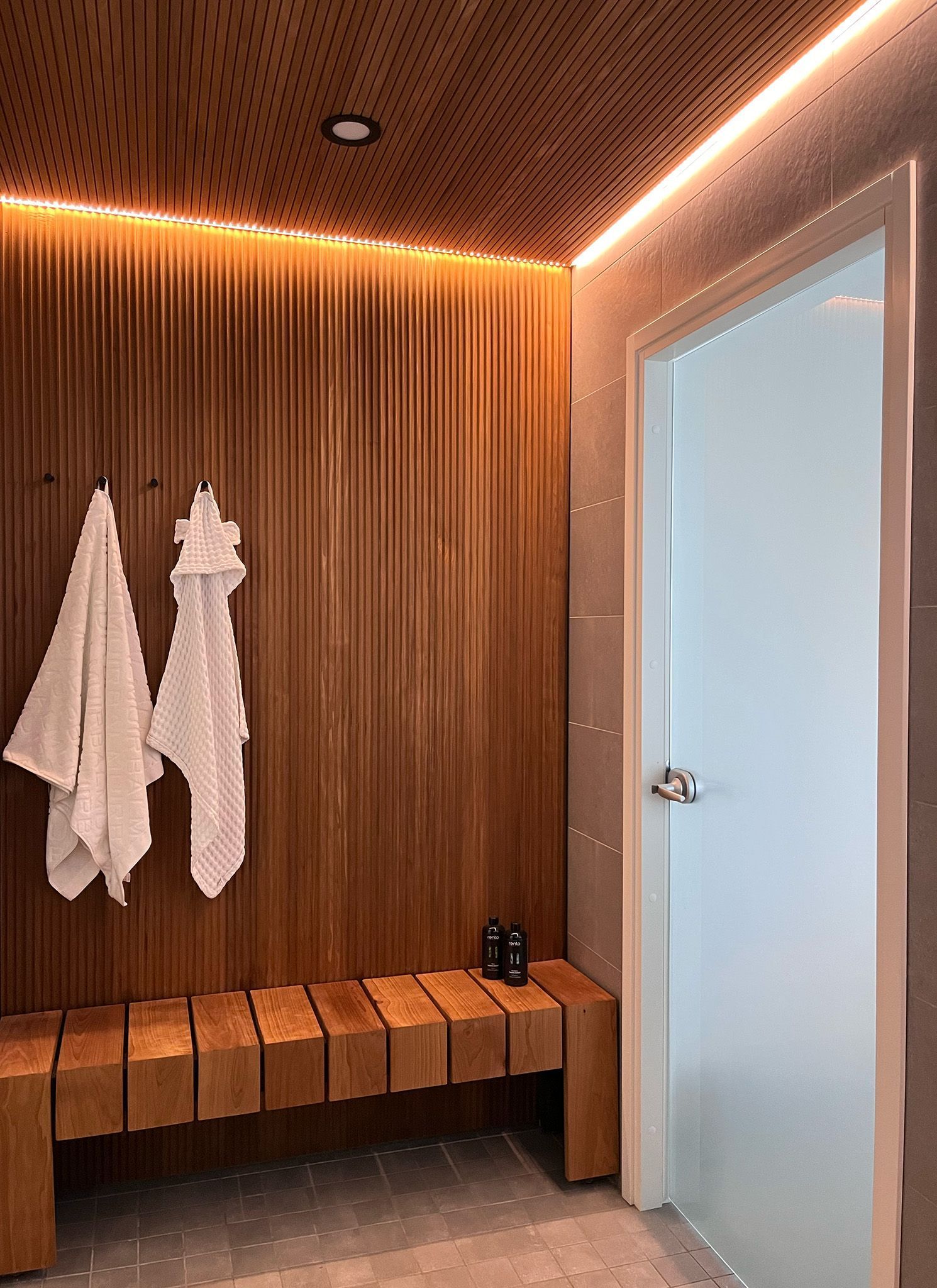
It is worth placing bright but glare-free lights around the mirror that illuminate the face evenly. Ceiling downlights provide good general lighting, and you can also add warm-toned indirect light, such as LED strips, to the shower area to create a relaxing atmosphere for an evening in the sauna. This way, bright general lights are not necessary when more atmospheric lighting is desired.
Toilet and utility room – practical and clear light
- Suitable general lighting: 150–250 lm/m²
- 150 lm/m² = calm general light
- 250 lm/m² = bright general light
In the toilet and utility room, the lighting should be sufficiently bright and even, but not too dazzling. In general, the amount of light can be (150–250 lm/m²).
It is worth adding a separate spotlight near the mirror or sink, which makes it easier to do precise tasks such as applying makeup, shaving or removing stains. In the utility room, task lighting is especially needed at ironing and laundry points – for example, an LED strip or directional downlight works really well in such a situation. Dimmable lighting makes the space more versatile and energy-efficient.
Hallways and corridors – a safe and inviting first impression
- Suitable general lighting: 150–250 lm/m²
- 150 lm/m² = calm general light
- 250 lm/m² = bright general light
Hallways and corridors are often the darkest places in the home, but lighting is very important there. A well-lit hallway makes the space inviting and makes it easier to get dressed and move around. The appropriate amount of light is 150–250 lm/m², meaning that 1500–2500 lumens is more than enough for a 10 m² hallway.
Low-profile downlights or LED panels work as practical general lighting, and brighter light can be added near the mirror for last-minute checks. Luminaires equipped with a motion sensor bring convenience and energy efficiency to hallways and corridors.
Summary – balanced lighting makes your home cozy
The most important thing in lighting design is layering: combine general lighting, spotlights and mood lighting for different purposes. When the amount of light is dimensioned according to the size, purpose and height of the room, the home is created as a whole that is both functional and cozy.
Shop reviews
4.6
number of ratings 165329- 5...5Atle T 8.10.2026

0
0
- Very good...Very goodGerard V 8.10.2026

0
0
- snabb leverans!...snabb leverans!Mats B 8.10.2026
0
0
- Todella nopea ja sujuva toimitus....Todella nopea ja sujuva toimitus.Pasi aatos P 8.10.2026

0
0
- Alltid lika bra....Alltid lika bra.Mathias Q 8.10.2026
0
0
- Kiitos hyvästä palvelusta ...Kiitos hyvästä palvelustaEeva V 8.10.2026
0
0
- Nopeasti on tullut, pakkaus ok....Nopeasti on tullut, pakkaus ok.Georgi M 8.10.2026
0
0
- Kjapp levering....Kjapp levering.Arnulf A 8.10.2026

0
0
- Read more(Taas) Nopeasti lähti paketti matkaan ja tuli hyvin pakattuna perille. Vielä ei ole yhteenkään teidän myymään tuotteeseen tarvinut pettyä! ...(Taas) Nopeasti lähti paketti matkaan ja tuli hyvin pakattuna perille. Vielä ei ole yhteenkään teidän myymään tuotteeseen tarvinut pettyä!R A 7.10.2026
0
0
- Super!...Super!Marcin N 7.10.2026
0
0
Easy and Safe Shopping
You can pay for the order safely and easily with Credit Card, Klarna, Paypal, Google Pay or Apple Pay. Shipping costs starts at only 3.90€. We use UPS and GLS for shipping.
Fast Delivery in 3-7 days (DHL/UPS/GLS)
Products in stock are normally shipped out within 1-2 working days. We process orders continuously and orders placed before 13 are normally sent at the same day. The shipment takes usually 3-7 days in Europe.
100% Satisfaction Guarantee
We want you to be 100% satisfied with your purchase. That's why we offer 30 days FREE returns if you are not happy with your product. Safe and carefree shopping at its best!

THE BIGGEST AND CHEAPEST LIGHT STORE IN THE NORDIC COUNTRIES
Lighting fixtures and their associated accessories are in a constant state of evolution - and so is our product selection. Within the VALOSTORE online shop, you will always discover the most cutting-edge auxiliary lights, headlamps, work lights, and handheld flashlights, along with top-tier accessories available in the market. Valostore boasts its very own light measurement laboratory, ensuring that we provide accurate information regarding the actual luminous output and other performance-related metrics of our fixtures. We warmly invite you to explore the VALOSTORE online shop and indulge in a shopping experience like no other!
VALOSTORE.COM
Handshake Finland Oy
VAT: FI23041120
Alasintie 9, 90400 Oulu, Finland
WHAT WE OFFER
- The best brands in the lighting industry
- Satisfaction guarantee
- 30-day free returns
- Safe payment methods
- Fast deliveries
- Free delivery across Europe on orders over 229 €. Free returns on all orders.
- Note: "UPS - Delivery across Europe"